
What Is Turkish Coffee?
A complete beginner’s guide!
Canva template by Shamblen Studios
Every week, someone sits across from me in one of my Turkish Coffee Fortune Sessions, squints at the cup in their hand, and asks:
“Dr. Honeybrew… what exactly is Turkish coffee?”
Not what does it mean… or what did you see… just what is it?
Which is funny, because Turkish coffee has been around longer than most of our family grudges. And yet, here we are, in 2026, Googling it like it just dropped on TikTok.
So, let me clear the fog.
Coffee, before it got complicated
First and foremost, Turkish coffee isn’t a bean. It also isn’t a roast or flavor.
It’s a method.
Back in the 16th century in the Ottoman Empire, coffee was ground into a powder soooo fine that it resembled cocoa dust.
It was then simmered slowly in a small pot we call cezve (pronounced JEZZ-vuh), poured unfiltered into tiny cups, and served as a ceremony.
All without paper filters, pumpkin spice, and that precious oat milk!
It’s a simple approach: just water, coffee, and patience.
Coffeehouses began to spread across Istanbul and beyond. They became places of poetry, politics, gossip, seduction, and even revolution!
In fact, Turkish coffee was declared so culturally significant that UNESCO eventually recognized it as part of the world’s intangible heritage.
And yet—the recipe hasn’t changed much!
An elegant classic, as I say.

Image by Amy Shamblen
How Turkish coffee is made
Here’s where many people get dramatic (it’s okay, I do too) and say, “it’s so strong!!”
That’s when I’ll tell you, “it’s not strong, it’s honest.”
The grind is ultra-fine… almost powder. Even finer than espresso. You combine it with cold water in a cezve, and heat it slowly.
That’s all it takes.
However, it’s important NOT to boil it! You’ll kill that precious foam and make it taste sour.
Just gentle heat.
The foam will rise. You pull it back. Foam rises again. You let it hover at that beautiful edge of chaos—that’s where the delicious magic happens.
Then you pour it out, grinds and all, straight into your demitasse cup.
Nothing is filtered out, which is important… because when you drink Turkish coffee, those precious grinds are then used to tell your future.
Why is Turkish Coffee so strong?
People confuse concentration with aggression (hey, I often do the same with my lovely wife).
Turkish coffee feels strong because:
the grind extracts deeply
the ratio coffee to water is intense
you’re also consuming some sediment
And that’s why it’s served in small cups: it demands respect!
But you’d be surprised—just because it feels strong doesn’t mean you’ll get a jitter attack. Espresso definitely wins in that department.
What makes it different from regular coffee?
Since my wife is a graphic designer, she made a handy little chart for your viewing pleasure:
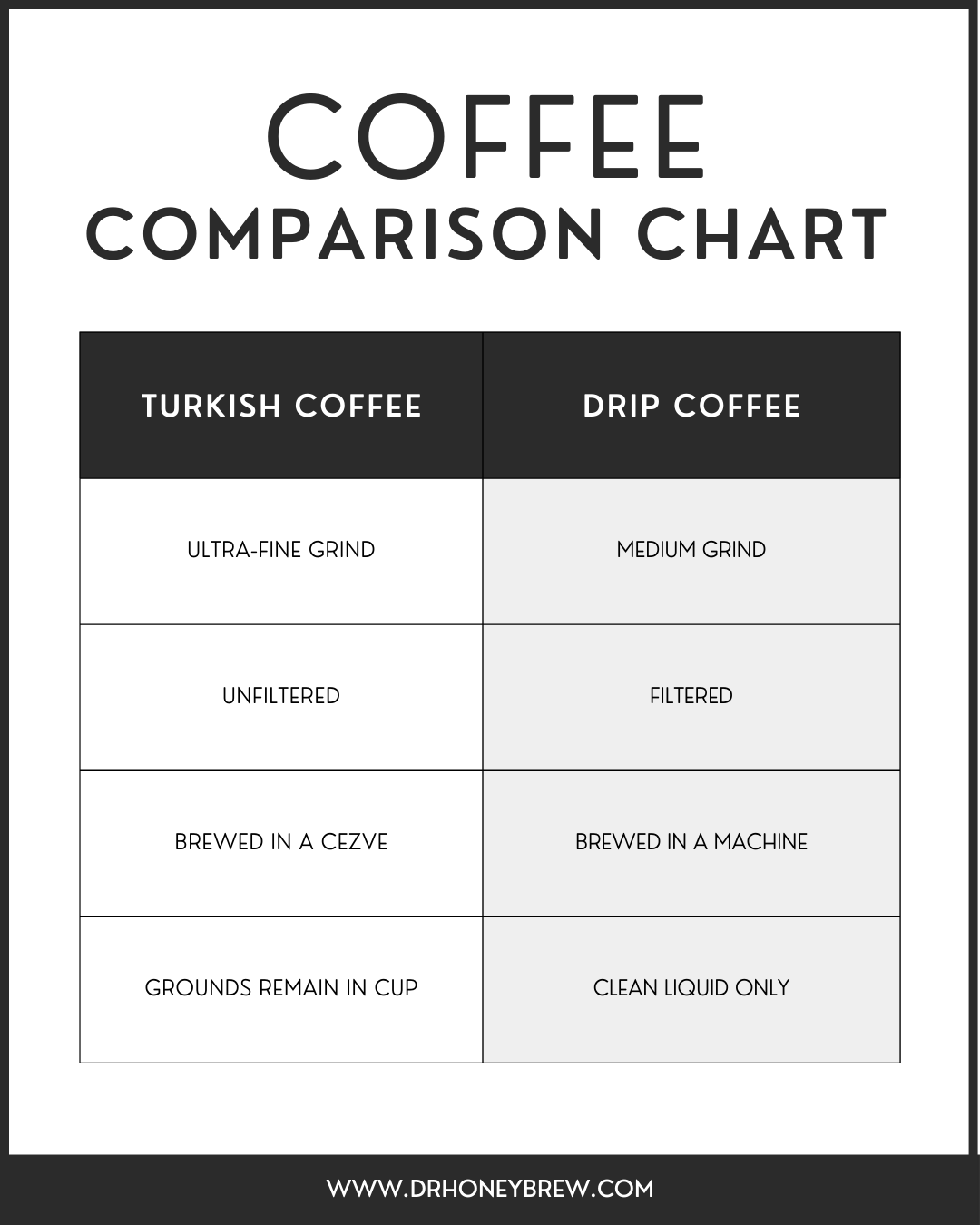
Essentially, one filters out the chaos, and one leaves it in. Guess which one I prefer ;)
The coffee flip
This is an integral part of the Turkish coffee experience (just don’t tell the conservative Turkish government who now consider it taboo).
When you finish your Turkish coffee, don’t rinse your cup!
Flip it upside down on the saucer.
Let it cool.
Wait.
We want to let the grounds slide, settle, and cling to the porcelain so they can form their vivid shapes, patterns, and suggestions.
Then, someone like me leans in and says what they see.
But before we get too mystical, it’s important to understand something:
The fortune reading didn’t invent Turkish coffee… Turkish coffee invented the fortune reading.
When you leave sediment in a cup, humans will eventually try to interpret it. That’s our hobby as a species, and why psychological tests like the Rorschach test was created.
We find meaning in the mess—we like to make sense of things and impose order to better understand what is happening. It actually helped us to evolve as a species!
So yes, Turkish coffee became the drink of fortune telling. But first, it was simple a ritual of hospitality.

Canva template by Shamblen Studios
Is Turkish coffee bitter?
It can be.
But so can honesty.
And honestly, I’ve personally never had a bitter cup. It’s all in the proper preparation—which is exactly what I do in the Turkish Coffee Room sessions :)
While many people drink it black, some order it sweetened. Traditionally, you choose your level of sweetness before it’s brewed… because once it’s in the pot, there’s no going back.
Which also feels metaphorical, but I’ll resist.
Is it stronger than espresso?
Technically, espresso may contain more caffeine per ounce.
But Turkish coffee is slower.
It’s meant to be enjoyed over conversation. Whenever we’re back in Istanbul, we’ll drink multiple cups of it a day… and it’s not uncommon.
It doesn’t shoot through you like espresso can. It sits with you…
…like a truth you’re not ready to admit (okay, couldn’t help that one).
Can you use regular coffee to make Turkish coffee?
Yes and no. But mostly no.
You can try… but it won’t behave. The grind won’t cooperate, foam up correctly, or settle the same.
When someone asks me this, I give them the American workaround: just put regular coffee into a cup, pour hot water over it, stir, and let it settle.
You can still read the grounds, but it isn’t the authentic experience. Turkish coffee requires total surrender to its method.
Why does any of this matter?
Because Turkish coffee isn’t just caffeine.
It’s a ceremony!
It forces pause. You can’t chug it while checking your Instagram. You can’t multitask through it.
You must sit. Sip. Wait for the grounds to settle at the bottom like thoughts at the end of a long day.
And sometimes, after the final sip, you flip the cup and reflect on what remains.
But even if you never care about fortune telling, Turkish coffee still holds its weight.
It’s a drink that refuses to filter itself for your convenience.
It leaves the grit in.
(I think we can all learn from that one!)
So when someone asks me, “what is Turkish coffee?”
I don’t say it’s strong.
I don’t say it tells fortunes.
I don’t say it’s an old tradition.
I say:
It’s coffee that doesn’t hide anything.
And if you’re curious what your cup might reveal after you finish it, well…
That’s another conversation.
Turkish coffee is the ritual, I’m the narrator.
If you’d like to know how I began reading cups in New York City—and why I never filter the truth—you can read more here.
